Tailored Development Aid
From deworming programs for schoolchildren in Kenya to protecting vulnerable communities in India from the impacts of climate change: Esther Duflo and Abhijit Banerjee use experimental approaches and concrete interventions to combat poverty.
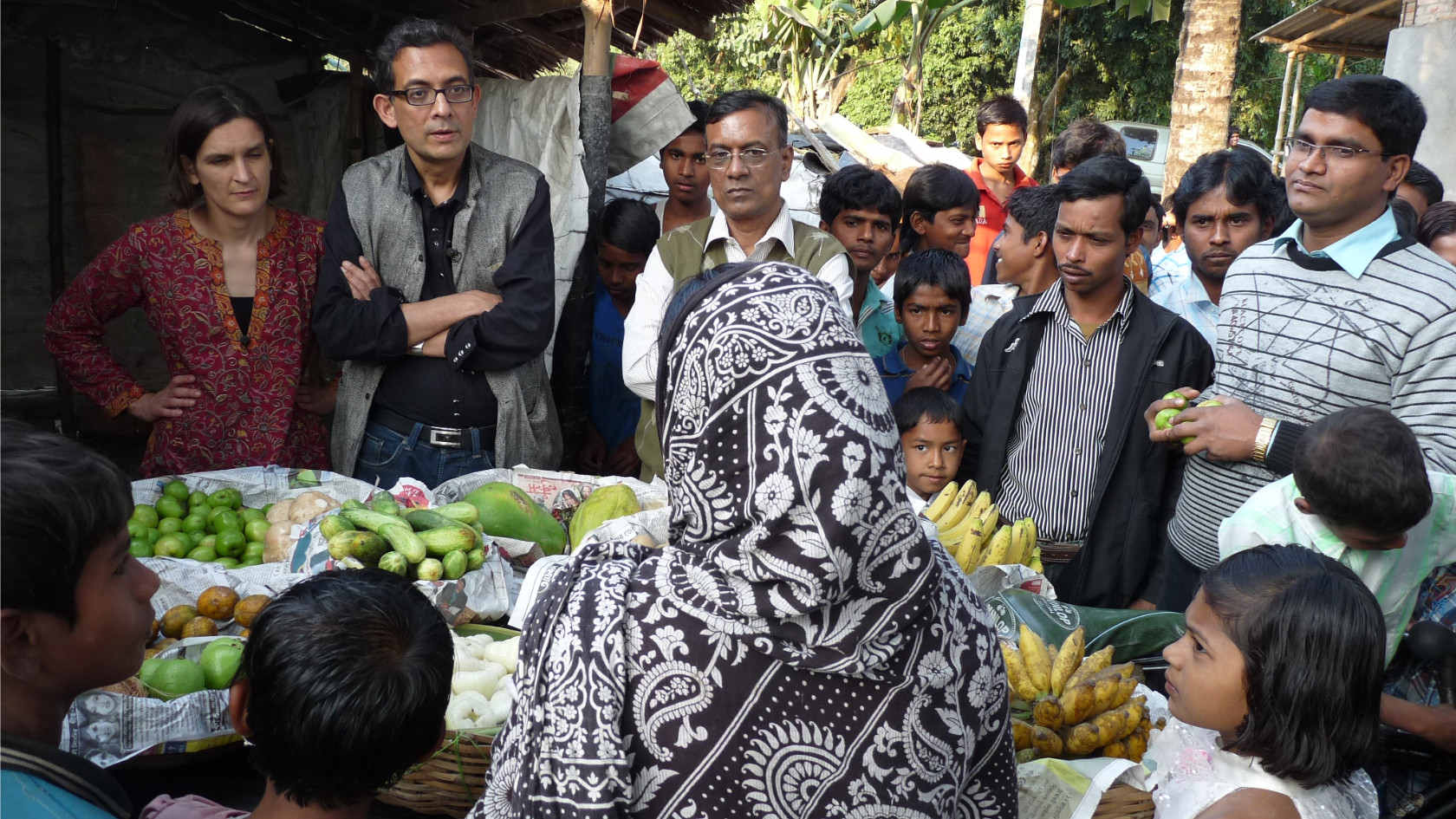
Esther Duflo, Abhijit Banerjee, you’re joining the University of Zurich this summer. What excites you most about this move?
Abhijit Banerjee: For us, the idea of being back in Europe is exciting, especially at this moment where Europe must affirm its values. Zurich is an ideal combination for us. The atmosphere and the researchers at UZH are great, and there is a very strong group working in development economics, in climate change, and in related areas.
In 2019 you were awarded the Nobel Prize for your experimental approach to alleviating global poverty. What is your fundamental insight from this work?
Esther Duflo: One fundamental insight might actually be that there is no fundamental insight. There is no silver bullet to get rid of poverty. To make progress, it’s important to look carefully at the various problems that are associated with being poor – education, health, environment, climate, governance, social protection, and many others – and then address these problems one by one.
And when we say addressing them one by one, we really mean addressing them with the same seriousness and rigor that you would apply if you were testing a new medical treatment or a new educational method. You ask a precise question, you test it carefully, and you analyze the results. In the same way that there is not one cure for cancer – because there are many types of cancers – there is not one fundamental insight that tells us how to solve poverty. That’s probably the most significant insight from our work.
Your strategy is to break complex issues down into smaller, testable questions.
Duflo: I don’t know if “small” is the right word, because “small” can suggest something very local or trivial. I would rather say “more precise” or “well-defined.” When you pose a well-defined question, you have a chance of getting a well-defined answer. And once you have such an answer – say, this particular approach to addressing this particular problem works – then you can think about scaling it up. If, instead, you find that an approach doesn’t work, which often happens, you can decide not to move in that direction.
A large part of the work of the Abdul Latif Jameel Poverty Action Lab (J-PAL) over the past 20 years has been not only to conduct thousands of research projects, but also to work very closely with policymakers to scale up what has been shown to be effective. Now, more than 800 million people have actually been reached by programs scaled up after they were evaluated by researchers in our J-PAL network. That is, of course, a very large number of people. But it didn’t happen all at once. It happened one step at a time, over many years.
With which project have you had the most success so far?
Duflo: One of the most interesting stories actually started in Davos. In one of the earliest J-PAL studies, Michael Kremer and Ted Miguel showed that it is extremely cost-effective to treat children preventively against intestinal worms in places where worms are prevalent. This study was conducted in Kenya, in areas with a lot of schistosomiasis, a parasitic worm infection which can be prevented by a pill given every six months. The pill itself is essentially free, and the cost of delivering it isn’t very high. Children who take this pill miss fewer days of school, and when they grow up, they earn about 25 percent more than children who didn’t receive the treatment. That is an extraordinarily significant effect.
In 2007, Michael Kremer and I were Young Global Leaders at the World Economic Forum in Davos, where we were encouraged to come up with ideas that could make a real difference in the world. So we proposed Deworm the World, a program to scale up this intervention. Of course, it took a long time to develop after that initial Davos meeting. It took a lot of work, and many people contributed. But the Young Global Leaders network was very helpful in getting it off the ground. It became a national policy in India, and has also reached many children in sub-Saharan Africa and elsewhere.
Read the complete article here.